The Future of LinkedIn Automation: AI Agents That Understand Intent
The era of "spray and pray" outreach is officially over. For years, sales teams have relied on volume to hit their numbers, sending thousands of generic connection requests and hoping for a 1% conversion rate. But today, response rates are plummeting, and decision-makers are tuning out static, templated messages. The future of LinkedIn automation isn't about sending more messages—it’s about sending smarter ones.
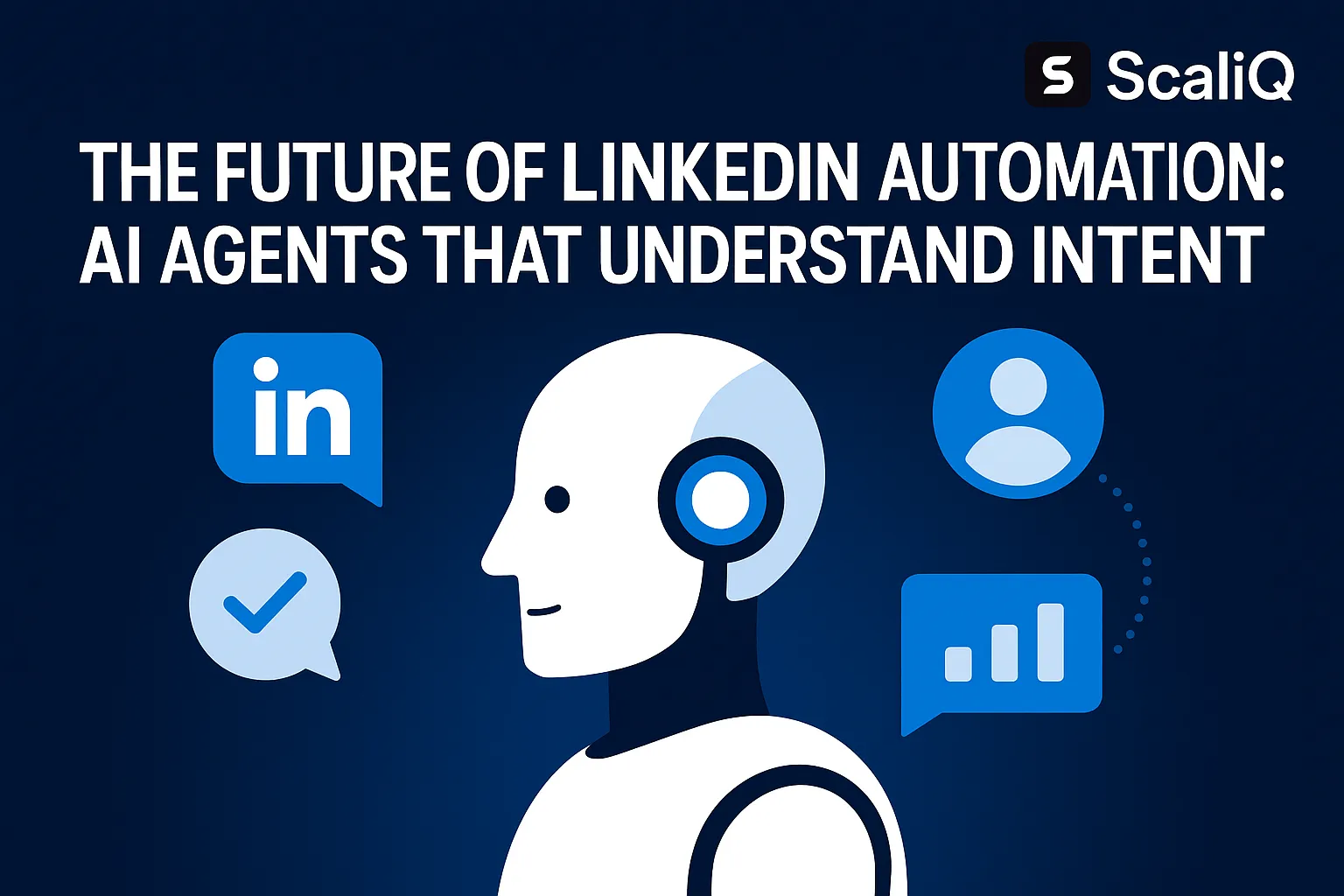
We are witnessing a paradigm shift from rigid, rule-based sequences to AI intent-aware agents. These are not simple scripts; they are intelligent systems capable of detecting buyer signals, understanding context, and adapting conversations in real-time. As early builders of conversational AI for outreach, ScaliQ has observed firsthand that success now depends on relevance, not volume.
In this guide, we explore how AI intent detection is redefining LinkedIn AI outreach, transforming how sales teams engage with prospects, and why the future belongs to adaptive agents rather than static automation tools.
Why Rule‑Based LinkedIn Automation Is Failing
Traditional LinkedIn automation tools were built for a different era. They rely on "if-this-then-that" logic: send a connection request, wait three days, send a follow-up. While efficient, this approach ignores the nuance of human interaction. It treats every prospect exactly the same, relying on static templates and bulk actions that often result in awkward, irrelevant messaging.
The pain points are becoming impossible to ignore. Generic messaging leads to low LinkedIn response rates, damages brand reputation, and increases the risk of being flagged by platform algorithms. Modern buyers expect adaptive personalization—conversations that feel human and relevant to their immediate needs.
While many tools claim to offer personalization, they often rely on superficial variables like {First_Name} or {Company_Name}. This is no longer enough. Furthermore, the ethical implications of automated communication are under scrutiny. According to Stanford’s ethical AI communication guidelines, transparency and relevance are critical to maintaining trust in digital communications. Ignoring these principles doesn't just lower conversion rates; it risks alienating your market entirely.
To solve this, we must move beyond static scripts. ScaliQ is tackling these challenges by deploying intent-aware agents that prioritize context over volume, ensuring outreach remains safe, compliant, and highly effective.
The Decline of Template-Based Outreach
User fatigue is at an all-time high. Executives receive dozens of pitches daily, most of which follow the exact same structure. This saturation has rendered traditional templates ineffective.
Even personalization frameworks popularized by tools like Lemlist—such as adding a prospect's name to an image—are becoming recognizable patterns. While visually appealing, they remain static. They do not account for why a prospect might be interested or when they are ready to buy. True personalized outreach automation requires understanding the prospect's current state, not just their demographic data.
Compliance and Platform Risk
High-volume automation carries significant risk. Bulk invites and repetitive templates are easy for LinkedIn’s algorithms to detect, leading to account restrictions or permanent bans. Safety in LinkedIn automation is no longer optional; it is a prerequisite for sustainability.
Adopting a responsible approach is essential. The government AI accountability guidelines emphasize the need for oversight and risk management in automated systems. By shifting from bulk actions to low-volume, high-relevance outreach, businesses can align with these safety standards while simultaneously improving performance.
How AI Intent Detection Elevates Personalization and Targeting
The solution to generic outreach is AI intent detection. This technology moves beyond static profile data (job title, industry) to analyze behavioral and micro-engagement signals. It answers the question: Is this person actually interested?
AI intent detection identifies buyer intent signals by processing how users interact with content and profiles. This allows sales teams to prioritize prospects who are actively engaged, rather than wasting resources on cold leads who are not ready to buy.
Data Signals AI Uses to Detect Intent
To accurately predict interest, AI analyzes a variety of public signals. These include:
• Content Engagement: Likes, comments, and shares on relevant industry posts.
• Profile Interactions: Dwell time on profiles or repeat visits.
• Search Behavior: Keywords and topics the user is publicly engaging with.
However, interpreting these signals requires sophisticated models. Research from the Harvard Kennedy School highlights the complexity of detecting intent in social media interactions, noting that context is often as important as the content itself. AI agents are designed to bridge this gap, synthesizing disparate data points to form a coherent picture of buyer interest.
Hyper‑Personalization Driven by Real Behavior
When outreach is driven by real behavior, the results are transformative. Instead of a generic "I see we are both in tech," an AI agent can reference a specific comment the prospect made about a recent industry trend.
This level of AI personalization boosts response rates significantly—sometimes by up to 300% compared to static templates. By adapting messaging based on real-time cues, sales teams can demonstrate that they have done their homework, instantly building credibility and trust.
What Adaptive Outreach Agents Can Do That Traditional Tools Cannot
It is crucial to distinguish between standard automation tools and agentic systems. Automation tools execute pre-defined commands. AI agents, however, possess multi-step reasoning capabilities. They can observe, decide, and act.
Adaptive outreach agents function like digital SDRs. They don't just send messages; they handle conversations, interpret replies, and adjust their strategy based on the flow of interaction.
Real-Time Message Adaptation
One of the most powerful features of adaptive outreach agents is real-time message adaptation. If a prospect responds with a question, the agent doesn't continue with a pre-set pitch. Instead, it analyzes the sentiment and content of the reply and adjusts its tone and information accordingly.
Unlike rule-based sequences found in common automation platforms, which often break when a prospect deviates from the expected path, adaptive agents thrive on nuance. They can shift from a sales posture to a helpful, educational tone instantly if they detect hesitation.
Multi‑Step Autonomous Conversations
True conversational AI for outreach goes beyond the initial hook. These agents are capable of managing multi-turn conversations. They can answer follow-up questions, provide clarification, and even navigate scheduling logistics.
This capability is supported by academic research. A study available via the NIH/PMC discusses the benefits of AI personalization in communication, noting that tailored, responsive interactions significantly improve user engagement and outcomes. By mimicking the responsiveness of a human SDR, agents keep deals moving forward without manual intervention.
Why Competitor Tools Can’t Match Agentic Behavior
Most competitors in the market, such as Apollo or Lemlist, excel at specific tasks like database enrichment or visual personalization. However, they generally lack real-time adaptation. Their workflows are linear: Step 1 -> Step 2 -> Step 3.
If a prospect asks a question in Step 2, a linear tool cannot autonomously answer it; a human must intervene. AI-powered sales outreach tools that utilize agentic behavior bridge this gap, handling the complexity of human dialogue that static frameworks simply cannot support.
Building Safe, Compliant, High‑Performing AI Outreach Workflows
Implementing AI agents requires a foundation of safety. Unlike the "growth hacking" tools of the past, compliant AI outreach focuses on limits, context retention, and transparency.
Compliance Framework (Based on Authoritative Sources)
To build a safe workflow, organizations should model their strategies on established guidelines, such as the Stanford AI communication policies and government accountability standards mentioned earlier. A robust compliance framework includes:
1. Human-in-the-Loop Oversight: Regularly reviewing agent outputs to ensure tone and accuracy.
2. Rate Limiting: Keeping activity well within LinkedIn’s usage limits to mimic human behavior.
3. Transparency: ensuring that the intent of the outreach is clear and deceptive practices are avoided.
Integrating AI Agents Into Existing Sales Stacks
AI agents are most effective when they are integrated into a broader sales ecosystem. They should feed data back into CRMs and work alongside enrichment layers.
While some platforms offer isolated solutions, true power comes from integration. For example, when discussing personalization assets or multi-channel support, tools like RepliQ can provide dynamic content that agents can deploy. Similarly, for orchestrated outreach workflows that span multiple channels, Notiq offers robust capabilities. AI prospecting tools that integrate seamlessly ensure that no data is lost and every interaction is tracked.
Workflow Blueprint for Intent‑Aware Outreach
A successful intent-based outreach workflow follows a specific logical path:
1. Signal Ingestion: The system detects a high-value action (e.g., a prospect visits the pricing page or comments on a post).
2. Intent Scoring: The AI scores the lead based on the strength of the signal.
3. Adaptive Messaging: The agent drafts a message tailored to that specific signal.
4. Conversation Handling: The agent manages replies and objections.
5. Human Handoff: Once a meeting is booked or complex intent is verified, the conversation is handed to a human closer.
ScaliQ excels in this domain, providing the conversational AI layer that powers these sophisticated flows.
Case Scenarios Demonstrating Adaptive Outreach Agents
To understand the power of this technology, let's look at two distinct scenarios where AI agents modify their approach based on intent.
Scenario 1: High‑Intent Signal (Commenter or Engaged Visitor)
Signal: A VP of Sales comments on a LinkedIn post about "AI in Lead Generation."
Agent Action: The agent identifies the topic of the comment. Instead of a generic intro, it sends a connection request referencing the specific insight the VP shared.
Follow-up: If accepted, the agent doesn't pitch immediately. It asks a thoughtful question related to their comment.
Result: The interaction feels like a peer-to-peer discussion, drastically increasing the likelihood of a booked meeting.
Scenario 2: Low‑Intent or Cold Prospect
Signal: A prospect fits the Ideal Customer Profile (ICP) but has shown no recent activity.
Agent Action: The agent adopts a "lighter touch." It sends a request focused on sharing a valuable resource or educational content, rather than a direct pitch.
Follow-up: The agent monitors for engagement with the content. If the prospect clicks, the intent score rises, and the agent shifts to a more direct conversation.
Advanced Strategies & Innovations Shaping the Future
The future of LinkedIn automation is moving toward fully autonomous systems.
Goal‑Driven Autonomous SDRs
We are approaching an era of goal-driven agents. Instead of programming steps, sales leaders will assign a goal: "Book 10 meetings with Fintech CTOs." The agent will then autonomously determine the best path, content, and timing to achieve that objective, iterating its strategy based on real-time feedback.
Predictive Engagement Scoring
Emerging trends in predictive scoring will allow agents to engage prospects before they even explicitly raise their hand. By analyzing subtle patterns in browsing and micro-engagement, AI will predict buying windows with high accuracy, allowing for perfectly timed outreach.
Conclusion
The transition from rule-based automation to intent-aware adaptive agents is not just a technological upgrade; it is a necessity for survival in modern sales. Static templates and bulk outreach are failing, replaced by intelligent systems that understand context, respect compliance, and engage buyers on their terms.
ScaliQ stands at the forefront of this evolution, building the conversational AI infrastructure that powers the next generation of LinkedIn AI outreach. For teams ready to move beyond the "spam folder" and into meaningful conversations, the future is agentic.